APPENDIX C General Rule 5 (a), states: The rules shall be administered in a match, by two umpires, who shall be mounted to enable them to keep close to the play, and a referee who shall remain off the field of play in a central positions. The decision of the umpire shall be final. The task of the referee is a very responsible one, and requires continuous concentration throughout the game. In many matches he may never be asked for a decision; and then, suddenly, an occasion arises when the umpires disagree and come to the referee for a ruling, and a definite and final opinion must be given. The referee should, therefore, have had considerable experience of good polo, and, if possible, of umpiring. He should not only know the rules well, but be able to refer any rule quickly. He should always have the Book of Rules beside him. When the umpires appeal to him to decide whether a foul occurred or not, the referee should confine his decision to this point, as laid down in Field Rule 24 and make no attempt to allocate a penalty. The reason for this is that official umpires have a certain scale of penalties, and once the referee has decided whether a foul occurred, they know what penalty to inflict. The referee is unlikely to know the umpires scale, and should, therefore, refrain from allocating a penalty unless specifically asked to do so. The referee should sit in a central position, at the side of the ground, apart from distracting influences, from which position he can see clearly and be easliy accessible to the umpires, who should know his exact position before play begins. No one should sit near the referee. Ponies Umpires in every class of polo must be well mounted to enable them to keep close to the game without having to concentrate on controlling their ponies. The practice of umpiring on young ponies in order to school them is strongly deprecated. Umpire’s Duties Before Game Begins 2. (a) It is important that the game should start at the time advertised. Whilst this is really the business of the Secretary in a big club, Umpires should be ready strictly on time and should ride out to the centre of the ground two minutes before the game is due to start. (b) The Umpire should check the following points before throwing the ball in:
Positions 3. (a) Division of Ground (b) Hit-in (c) Penalties 2 and 3 See changes / updates to the Rules at the top of the page It is even more essential that one Umpire should be on the back-line in 30 and 40 yard hits as the defending side may not cross the back line until the ball is hit or hit at, or come out between the goal posts. Infringement of this Rule has such strong penalties that it is obvious that an umpire should be on the goal line, otherwise it will be impossible to detect this infringement. (d) Penalties 4 and 5 (a) and (b) In the case of the 60 yard hits and the free hits (in the event of the latter being fairly near goal) it is also important that an umpire should be close behind the line. in the melees which frequently result from these penalties close to and in front of goal, the hooking of sticks from the wrong side often occurs, and it is difficult to see unless the umpire is close. (e) It follows that if these positions are mutually agreed to by the two umpires, the general position of the two umpires, whatever direction the game goes in, will be that one umpire will be more or less at a short distance behind the game while the other is galloping level with it. It is considered that this is the ideal combination of the two positions to make certain of seeing every possible infringement of the Rules. Use of Whistle - General Rule 7 (f) 4. (a) Be careful to use the whistle correctly. Remember there is a timekeeper who has to stop the clock when you blow a firm blast. Although you should not normally blow the whistle when the attacking side hits behind you must be on the lookout to do so if the defending side hits behind, as this will entitle the attackers to a 60-yard hit opposite where the ball crossed. (b) The umpire should carry his whistle on a chord around his neck and the whistle should always be in his mouth ready for instant use and must make up his mind in a flash and blow without hesitation. Owing to the pace at which polo is played, any momentary delay is fatal as situations change so rapidly that an umpire may end up by not blowing his whistle at all for a foul that he really meant to give. (c) The umpire having blown his whistle should quickly check with the other umpire that he agrees there was a foul and to the proposed penalty. This can be done either verbally or preferably by a nod of the head or some other prearranged signal. it is most important that there should be no delay through long discussion. The umpire should then loudly and clearly announce the foul and penalty, thus "Cross against Red, Free hit from the Spot", and without waiting, canter to the spot where the foul occurred, drop the ball and go to his position, There is no necessity to state the number of the penalty awarded. Referee 5. If the umpires disagree, they should refer the matter to the referee for final decision; but should confine their request to a decision as to whether or not a foul occurred and only ask for a decision as to the penalty if they are unable to agree on this point also. The reason for this is that umpires have a certain scale of penalties and, once the referee has decided whether a foul occurred, they know what penalties to inflict. The referee is unlikely to know the umpires scale and should therefore refrain from allocating a penalty, unless specially asked to do so. Concentration 6. Owing to the speed at which it is played, polo is the most difficult of all games to umpire. The umpire must be concentrating on the play every moment of the period; he should be watching the game so closely that he is certain of the line of the ball each time it has been hit, and, consequently, knows at a glance which player has the Right of Way. He must further establish the direction of the Right of Way (in his mind) bearing in mind that it is very likely that the Right of Way and the Line of the Ball will not coincide. The moment the line of the ball is changed he must quickly know who is now entitled to the Right of Way and in what direction the new Right of Way lies. Attention is drawn to Field Rule 16(j). It is the umpire's job to see that the player who has Right of No Way is given sufficient room to pull up or turn when the Right of Way changes suddenly. A common error among inexperienced umpires is lack of concentration due to watching some brilliant individual move or combined play, more from an appreciative point of view of the spectator than as an umpire. No appealing - General Rule 5 (f) 7. Only the captain shall have the sole right to discuss with the umpire or umpires any matter arising during the game. No player shall a peal in any manner to the umpire for fouls. This includes a player holding up his stick for which he may be penalised after a warning under Field Rule 24. If thought necessary a general caution to all player should be given at the beginning of a match or chukker after which any appeal for a foul may be penalised without further warning. It is very necessary that there should be no haggling or long discussions between umpires, and the right of a captain of a side to discuss matters with the umpire does not include the right to challenge the umpire's normal decisions. Never get into an argument with the players. It is unnecessary to discuss anything with the players while playing, or explain reasons for giving any decisions; but, in the interest of the game, when it is over, a discussion on the game and the fouls that occurred will be found helpful, especially to young players. Prolongation in the Event of a Tie General Rule 7 (h) 8. Remember that if a game ends in a tie at the end of the final period it must carry on after the bell is rung/or bugle sounds until the ball goes out of play, or the 30 second bell is rung/or bugle blown. Allowing a Goal after Whistle 9. Read carefully Note to Field Rule 2 as to when a goal may be allowed to stand after the whistle is blown - for a foul. Field Rule 3, 4 and 5 10. The method of dealing with offences under these Rules is given in detail in Penalties 9 (a), (b) and (c) respectively. These offences concern unmanageable ponies, blinkers, frost nails, sharp spurs and protruding buckles on boots and knee pads. The umpire should ride up to the captain of the team and direct him to tell the player to change his pony or remove the offence. Note that if a pony is disqualified (Penalty 9 (a)) or a player is excluded (Penalty 10), a written report is required from the umpire. Changing Ends - Field Rule 9 11. Remember that, if by half-time no goals have been scored, ends will be changed. Remember also that if a goal has been scored, it is laid down that teams should return to the centre at the pace of a slow canter. it will be found that, in an exciting match, when the score is level or nearly level and the last period is being played, one team or the other, or both, will gallop back to the centre to get the ball thrown in. Remember to stick to the canter when returning to the throw-in. Crossing - Field Rule 16 12. (a) It is difficult to specify the distance at which a cross occurs but in all doubtful cases of crossing the pace at which the players are moving must be considered, or whether there is any danger involved, as on this depends the question whether the player entitled to the Right of Way has to check to avoid a collision. The benefit of the doubt should be in favour of the man entitled to the Right of Way. The good umpire gets consistent in giving penalties for crossing, and this is more appreciated by the players than anything else.(b) A frequent form of foul is committed by a player swinging his pony across the Right of Way immediately before or after hitting at the ball. This often occurs after taking a nearside backhander. Another foul under this Rule is checking for a backhander (even when the striker is entitled to the Right of Way) when an opponent is following close behind in full pursuit. On the other hand, once a player has safely taken over the Right of Way from another player, the latter may not ride into the former from behind unless the former checks his pony. (c) Umpires are apt to forget that a player riding in the direction that the ball is travelling at an angle to its line has the Right of Way over a player riding to meet the ball at an angle to its line, irrespective of the width of the angle, provided he takes the ball on his off-side. It is only when a player rides to meet the ball on its exact line that he has the Right of Way over all other players riding at an angle from any direction. Dangerous Angle - Field Rule 17 (a) 13. The Umpire when deciding whether a bump was made at a dangerous angle, should consider the speed at which the player was riding and whether the bump could have caused the pony to fall, for example a bump behind the saddle at an acute angle. Players should straighten out almost parallel with their opponents before riding them off. Intimidation - Field Rule 17 (e) 14. This Rule should be carefully read and strictly enforced. Incorrect Use of Stick - Field Rule 19 15. The Rule states that the stick may be only hooked when an adversary is in the act of striking at the ball and that a player is not allowed to strike or hook an opponent's stick above the level of the shoulder. It should be noted that no player may strike at the ball among the legs of an adversary's pony and that the hind legs are included in this Rule. However, if a Player rides into the backhander of a player entitled to the Right of Way, he does so at his own risk. The same Rule states that no player shall intentionally strike his pony with his polo stick. A player is prohibited from intentionally striking his pony with the shaft or even thumping it with the butt end of the handle. Some examples of dangerous use of stick are:
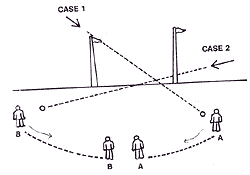
Accident or Injury - Field Rule 22 (a) 16. This Rule states: "If a pony falls or goes lame, or if a player or pony be injured, or in the case of an accident to a pony's gear which, in the opinion of the umpire, involves danger to a player, or other players, the umpire shall stop the game". It is not considered practicable to lay down hard and fast rules as to what accident to a pony's gear is dangerous or not. For instance, a broken martingale may not be dangerous, but if broken in such a way that one end trails along the ground, it is so. As a guide it may be accepted that generally a broken curb-chain, broken stirrup leather and in some cases, a broken martingale, are not considered dangerous; they are, moreover, the result of careless stable supervision; and the player concerned will have to change his pony, if he wishes, without the game being stopped. Responsibility, for deciding what is or is not dangerous, how ever, must remain with the umpire. Discretion of Umpires - Field rule 24 17. This Rule empowers umpires to penalise all dangerous and unfair play and bad behaviour on the ground that is not mentioned in the Rules. Penalties 18. (a) There are no less than five separate penalty hits (Penalties 2 to 5 (b): The 30-yard hit As regards the actual penalties themselves there are ten. Umpires must know these by heart, but there is no longer any need to know the numbers, since the rules give the name to each penalty, which should be used in perference to the number. (b) Penalty 1 The ruling of a Penalty Goal states: 'If, in the opinion of the umpires, a player commits a dangerous or deliberate foul in the vicinity of goal in order to save a goal, the side fouled shall be allowed one goal". The umpire, having awarded a penalty, goal, shall immediately instruct the goal judge to wave the red flag. A clear definition is sometimes asked for as to what vicinity means in terms of distance from the goal. The fact that the foul is considered to have been committed in order to save a goal obviously denotes that the player fouled is in a position to score, and is therefore, in most cases, close to the goal. It is difficult to lay down any actual distance to cover "vicinity" but this Penalty Goal has seldom been given at distances exceeding the 40 yard line unless the Player fouled is more or less in front of goal and had an open run at the goal if he had not been fouled. (c) Penalty 2 See changes / updates to the Rules at the top of the page Remember that the wording for a 30-yard Hit is: “A free hit at the ball from a spot 30 yards from the goal line of the side fouling, opposite the middle of the goal, or, if preferred, from where the foul occurred (the choice to rest with the captain of the side fouled)"... It is therefore, clear that an umpire, if the foul occurs anywhere nearer the goal than 30 yards, should immediately ride up to the captain of the side fouled and offer the choice of a free hit from 30 yards or from the place where the foul occurred; he should not decide this matter himself, and he should remember that in the latter case the fouling side may not be within 30 yards of the ball, nor may they come out between the goal posts. (d) Penalty 2 and 3 See changes / updates to the Rules at the top of the page It is of the utmost importance to remember that in carrying out 30 or 40 yard hits, if the hit would, in the opinion of the umpires have resulted in a goal, but is stopped by one of the side fouling coming out between the goal posts, or crossing the back line before the ball was struck, such a shot is to count as a goal to the side fouled. If the Player who stopped the ball did not infringe these Rules, but another member of the side did, then the fouled side should be allowed another hit from the same position Penalty 7 (a). This bears out the importance of one umpire being on the back-line. (e) Penalty 4 and 5 (a) Remember that, in 60-yard hit and Free hits from the spot and centre, the umpires should see that side fouling should stand 30 yards from the ball before it is hit or hit at. In view of the fact that there are large number of 60 yard hits, umpire can train their eyes very quickly as to where 30 yard is, as there is a 30 yard line marked on the ground as well as a 60 yard line. Remember that a Free hit (i.e. from where the foul took place) can be as severe as a 30 or 40 yard hit, for it is clear that if an infringement of the Rules takes place, say, 15 yards in front of the goal for which the umpire decides that a Free Hit is suitable, the side fouling must be 30 yards from the ball when it is hit or hit at, and will, therefore, be 15 yards behind the goal, thus making the goal almost a certainty. If an infringement occurs calling for the exercise of a 60 yard hit opposite the goal or a Free hit from where the foul took place, at a point nearer the goal line than 60 yards, then a Free hit from the spot should generally be given and the side fouled get the benefit of having the better chance of scoring a goal than if they had been given Penalty 4 and taken back to 60 yards. However, the gravity of the infringement must be the deciding factor in the umpire's decision. (f) Penalty 5 (b) Umpires should bear in mind that the object of Penalty 5 (b) a Free Hit from the centre of the ground, is to give umpires an additional penalty, which may be awarded at their discretion, in circumstances where a Free Hit from the spot is considered inadequate and to award a 60 yard Hit would be too severe. For example: the attacking side commit a minor infringement in the vicinity of the defender's 60 yard line. An Umpire may award a Free Hit from the centre of the ground if he considers a Free Hit from the Spot inadequate and a Penalty 4 too severe, as this would entail taking the attackers back behind their 60 yard line. General Rule 6, page 7 states: 'An Official Timekeeper and Scorer shall be employed in all games and matches'. The length of each period/chukker is 7 minutes. The time during which a penalty is being exacted or an accident being dealt with does not count in the 7 minutes playing time. The fact that the time is not to be counted (i.e. the clock is to be stopped) is indicated by the umpire blowing one firm blast on his whistle. The time starts to count again (i.e. the clock is to be started) when the umpire says 'Play' and the ball is hit or hit at. The Timekeeper will find no difficulty in excluding the time required for penalties and accidents from the playing time of the period if he is provided with a proper polo stop clock. If none is available, two ordinary stop watches will do, one being used to record the time from the commencement of the period and the other for noting the time to be added to the first watch on account of penalties and accidents. It is the timekeeper's duty to ring the bell/get the bugle sounded when the 7 minute period finishes, and again 30 seconds later if play has not already stopped. Great care must be taken that the first stroke of the bell coincides exactly with the termination of the 7 and 7 1/2 minutes, for, in the case of a close match in a final period, a ball may pass between the goal posts a second before or after the correct time of the conclusion of the period. The timekeeper's responsibility in this matter is, therefore, of great importance. Between each period there is an interval of three minutes. In all matches there is a half-time interval of five minutes. Should play begin before the three minutes are up, it is unnecessary to ring the bell but the clock should be started at the moment that play begins. If the play has not begun at the end of each interval, the timekeeper shall ring the bell, but he must not start the clock until play actually begins. In the event of a tie requiring that an extra period be played, the interval shall be five minutes. In this case it is the umpire's duty to see that the game is not started again until the five minutes' interval has been taken. General Rule 7 (j), page 11 is extremely important to the timekeeper, as he is the only official who can carry out this rule. It reads: 'In the event of a penalty being awarded within twenty seconds of the end of a match, the timekeeper shall allow 20 seconds play from the time the ball is hit, or hit at, in carrying out the penalty, before he rings the final bell. If a goal is scored after the ball has been put into play, the final bell shall be rung, if the original regular time has expired. The match shall terminate, as usual, on the first stroke of the final bell. Thus, if the whistle blows for any foul committed by any team when there are less than twenty seconds to go before time in the final period, it is the duty of the timekeeper to allow twenty seconds more play from the time the ball is hit, or hit at, in taking the penalty. The timekeeper should be provided with a red flag. When the Goal Judge signals a goal by waving his red flag, the timekeeper should acknowledge by waving his flag in reply; he must keep the scores on a proper form, and see that it is correct put up on the board. The timekeeper should fully understand Penalty No. 1 (penalty goal), (page 33) when the umpire orders the goal judge to signal a goal as a result of a foul in the vicinity of goal, and throws in the ball to restart the game at the spot where the goal occured. Also General Rule 7 (g), (i) and (ii) (page 10) In International and important open cup matches, committees are advised to appoint a member of the committee or designate some suitable official, to sit with the timekeeper to assist him in his responsible duties. General Rule 5 (b), page 5 reads: 'In all matches goal judges shall be appointed each of whom shall give testimony to the umpires at the latter's request in respect of goals or other points of the game near his goal, but the umpire shall make all decisions'. A flag should be waved, when a goal is scored, until acknowledged by the timekeeper. This flag should be kept down and furled when a goal is scored. Remember, an umpire may order a goal judge to signal a goal for Penalty 1 without the ball having actually passed through the goal. When the ball is hit behind, a goal judge should quickly place a new ball on the spot where it crossed the line, remembering that it must not be nearer than 4 yards to the goal posts or the side. Remember, the umpires may at any moment ask the goal judge's opinion on the question of whether the defending side hit the ball behind the goal-line or back-line or on other points of the game near the goal. The umpires however, make all decisions. Sometimes the ball rolls only a few inches over the goal-line between the posts or is hit back again by a defender just as it has crossed the line. This must be carefully watched for. Goal judges should wear white coats (long ones are not recommended), and keep out of the way of the players. Many polo players and umpires will remember difficult situations when a goal has been shot at from an acute angle, particularly if the ball has passed above the level of the goal posts. The normal single goal judge, standing well back behind the centre of the goal, may be in doubt whether it was a goal but must either signal a goal or not. The umpire, whose decision is final, can intervene but may not have been in a position to see more clearly than the goal judge. If two goal judges are posted on each end; such a situation should not occur. They can stand together behind the goal when the game is running towards the other goal; but the moment an attack on their goal is coming, one of them should always keep moving so as to keep the approaching ball in view through the goal posts, particularly when it is actually struck at goal, For examples:
The game has come down the left side of the ground, and goal judge 'B' moves out on the imaginary dotted line to the right. Watching the approaching ball between the goalposts. Goal judge 'A' remains in the centre. Case 2. The game has come down the right side of the ground; Goal judge 'A' moves out on the imaginary dotted line to the left, watching the approaching ball between the goalposts. Goal judge 'B' remains in the
centre. |


 Case 1.